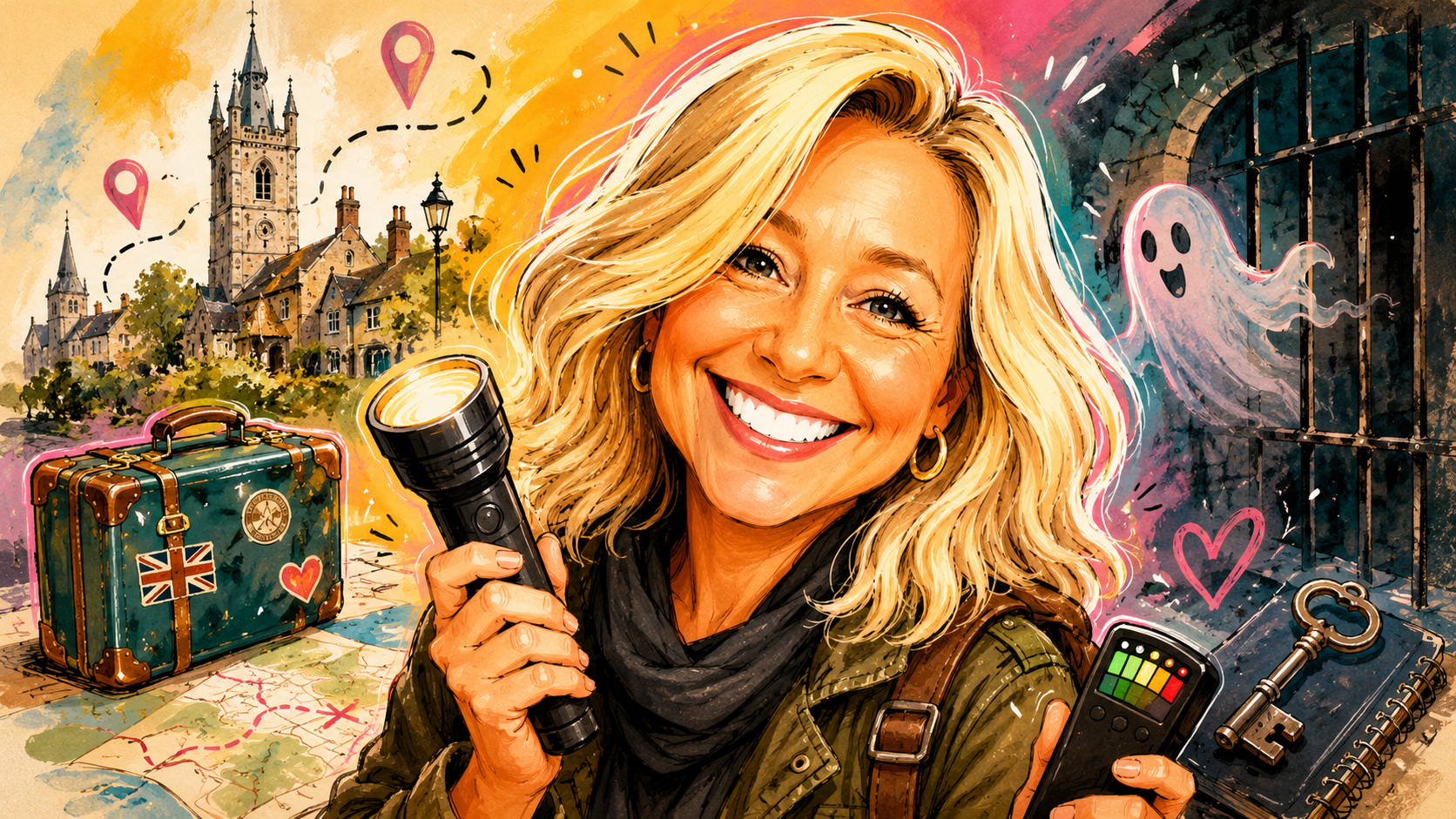

Pip: Welcome to Roaming Towards Myself — where one Australian on an eleven-month European holiday apparently packs ghost-hunting equipment the way most people pack a spare jumper.
Mara: debbieterrantroy has been writing across some genuinely distinct territory lately — haunted prisons, a village with a ghost problem, and the quieter, more personal work of recovery and what it looks like when depression starts to lift. Let’s start with the haunted places.
Haunted Places And Ghost Stories
Mara: The question this segment is really asking is whether a place can hold something — whether the history inside old walls shows up when you go looking for it at night.
Pip: The Shrewsbury Prison post sets the scene directly: “A ghost called John in a prison morgue taking a liking to me? Sure. Why not. Add it to the list. It would undoubtedly be a better relationship than my last one.”
Mara: Which is to say, the night produced actual encounters — a shadow crossing a room, bells moving in response to questions, a Ouija board session with what felt like a child and her mother, and an EMF spike during a conversation about a convict ancestor.
Pip: The prison’s history earns that atmosphere. Executed prisoners buried in unmarked graves inside the grounds, the last hanging in 1868, the final execution in 1961. That detail about unnamed burials inside the same walls you’re walking through at 3am is the thing that actually lands.
Mara: And then there’s Pluckley — England’s most haunted village, Guinness Book of Records 1989 — where the ghost walk didn’t produce any encounters, but the village itself held up on its own terms. The Dering windows, the nine-hundred-year-old church, the local brickworks, a village tea. The ghost stories sit inside a much older local history.
Pip: No ghosts, but architecture with a backstory. Honestly, sometimes that’s enough.
Mara: There’s also a call for submissions — a post collecting true ghost stories from real people in Australia, the UK, and France, for a future book project. Footsteps, shadows, cold rooms, objects moving. The ask is simple: just tell what happened.
Mara: That book project is where the personal experience of haunted places starts connecting to something larger — and that instinct to document, to make sense of hard things, runs through the next segment too.
Mental Health And Recovery
Pip: This segment is about what recovery actually looks and feels like from the inside — not the clinical description of it, but the small signals that something is shifting.
Mara: The post on depression lifting puts it plainly: “The fact that I’m even noticing these moments again means the grey is fading. I’m seeing beauty in the world around me again.”
Pip: That’s the measure — not a milestone or a test result, but noticing that a blossom tree looks pretty and stopping to photograph it. The nervous system catching up to the moment.
Mara: The post on travel and depression traces the earlier part of that arc. Before Thailand, music had stopped. Therapy and medication were in place, but the environment itself was saturated with painful memories. Then, standing in immigration after a delayed flight, something had already changed — small inconveniences just didn’t matter anymore. The nervous system was beginning to settle.
Pip: A delayed flight as a diagnostic tool. That’s a new one.
Mara: The travel post is careful about this — travel didn’t cure anything. Therapy, medication, support all mattered. But changing the environment gave the mind space to remember what calm could feel like. That framing matters.
Mara: And then there’s the children’s book, How’s Your Head, Mummy? — a picture book for young children trying to understand a parent’s hard days. It reassures children that a parent being tired, sad, or unwell is not their fault, and that they are still loved and safe. That’s the same territory approached from the other direction: not what recovery feels like to the person living it, but what it looks like to a small child watching from the outside.
Pip: The grey fading, the bells ringing, the book for the kids — all of it is the same project, really.
Mara: Documenting what it means to come back to yourself, one place at a time.
Pip: Haunted prisons and lifting depression don’t sound like they belong in the same conversation, but they do — both are about what stays with you inside a place, and what you carry out.
Mara: Next time, more of that — wherever the road goes next.
Subscribe for free.
Get new posts from Roaming Towards Myself — budget travel, ghost hunting, mental health, moving overseas in your 50s, empty nester life, writing, and starting again.
Leave a Reply